Conversation intelligence for recruitment (2026)

Tool information was verified via public vendor pages, May 2026. Simply is not affiliated with the vendors mentioned. Prices and features may change, check the vendor site for the current state.
What is conversation intelligence (and why does it come from sales)?
Conversation intelligence, often shortened to CI, is software that analyses conversations automatically. Not just transcription, but pulling patterns out of them. Who spoke how much. Which topics came up. What the tone was. Which follow-up actions were agreed. A good CI tool makes every conversation searchable at word level, logs it automatically into the CRM, and gives you a scorecard you can use to lay conversations side by side.
The category emerged around 2015 in the sales world. Gong was the pioneer, Chorus followed quickly. The problem they solved was specific: sales managers wanted to know why one account manager closed deals and another did not. By recording and analysing all sales calls, a feedback layer appeared. Talk-to-listen ratio became a thing. Did a rep talk too much? Did they ask enough questions? Which competitors got mentioned, and at what moment did a deal tip? That is where the terminology of conversation intelligence comes from, and it is worth knowing, because it explains why much of the market still carries a sales frame.
For recruitment that frame is only partly useful. A recruiter does not run a sales call. An intake conversation with a candidate has a different purpose than a demo with a prospect. You are not forecasting a deal, you want to understand a candidate, capture the right data, and assess consistently. The underlying tech (speech to text, extracting structure from conversation, analysis across multiple conversations) is the same. What you do with it is fundamentally different. So the question is not "which CI tool is best", but "which CI tool is built for the work I actually do".
What does conversation intelligence do for recruiters in practice?
Set the marketing aside. What does it give you on a Tuesday morning? Five things, in order of how often they come up in recruitment work.
From intake to structured CRM data
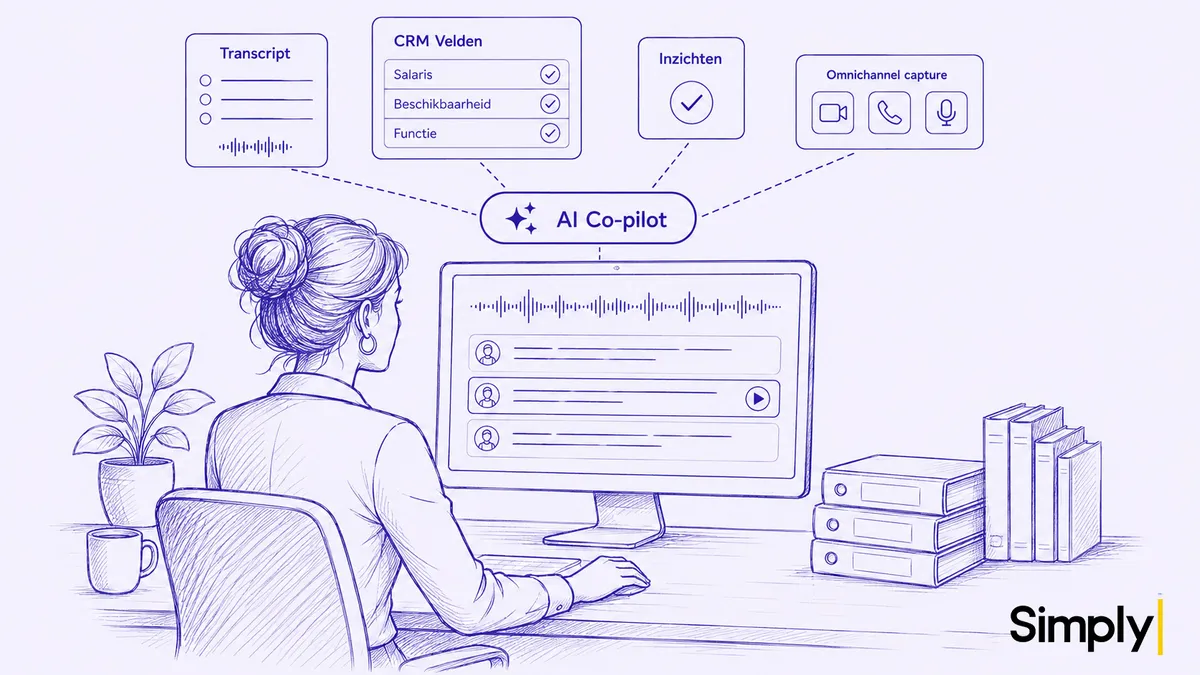
For most recruiters this is the biggest time saving. After an intake conversation you normally spend twenty minutes writing up your notes and filling in fields: desired salary, availability, current role, reason for leaving. A recruitment CI tool pulls those data points out of the conversation automatically and puts them into the right fields of your ATS or CRM. Not as a loose summary you then have to retype, but as filled-in fields.
The difference between a good and a mediocre tool sits in the validation here. A sales CI tool that recognises "company name" and "deal size" is a different thing from a tool that knows "desired salary" is an enum, that a mobile number belongs in a phone field, and that "available immediately" means something specific for your planning. Simply solves this with a validation system that indicates per field how confident the AI is: green when it is right, orange when the recruiter should check. See how that works in CRM data entry. You do not fill in blind, you check where it matters.
Candidate insights across multiple conversations
A single summary is useful. But the real value appears when the tool picks up patterns across multiple conversations. What did this candidate say about their motivations in the first chat, and does that line up with what came out in the second round? Which candidates in your pool specifically mentioned interest in a hybrid role? For secondment firms and agencies working from their own database, this is the difference between a static CV and a living candidate profile. Simply builds on this with candidate and recruiter insights: not just what the candidate said, but which traits and signals recur across conversations.
Coaching and consistency for recruiters
This is where the sales heritage shows up most clearly, and where it is also useful. Talk-to-listen ratio and scorecards were once meant to coach reps, but the same mechanics work for recruiters. Does a recruiter talk too much in an intake and ask too few open questions? Are the same competencies covered for every candidate, or does it depend on the day? A team lead who can lay ten intakes side by side sees where the inconsistency sits. That makes onboarding new recruiters faster and conversation quality across the team more even.
Worth being honest here: Simply does not publish talk-ratio or sentiment as standalone, named features. What Simply does steer on is the structure of the output (fixed summary types per conversation type) and the recruiter insights that follow from it. That is a different route to the same goal: consistency and quality, without slapping a sales scorecard onto a recruiter.
Less bias through structure
This is sensitive and deserves a sober tone. Conversation intelligence does not reduce bias on its own. What it can do: enforce structure. If every conversation is summarised along the same lines and captured against the same criteria, you assess candidates more consistently than when everyone runs on their own gut. Research into structured interviews has pointed the same way for years: a fixed structure raises the predictive validity of a selection conversation considerably (SHRM cites improvements in the order of a quarter, though this varies by study). A CI tool that imposes structure helps you closer to that consistency. It is not a bias button. It is an aid that makes it easier to compare fairly. For the legal side of this, see the guide on GDPR and the EU AI Act for recruitment tools.
Omnichannel: the phone and the in-person conversation too
This is where most tools, and certainly the ones born in sales, fall short. Sales CI is built around video calls and sometimes VOIP for outbound sales. But recruitment happens everywhere. A quick screening on a mobile number. A first meeting at the office with no screen between you. An intake over Teams. A tool that only captures your Zoom calls misses half your conversations. Simply records across all channels: meeting bots for Google Meet and Teams, a desktop app, a mobile app for in-person conversations, and VOIP including Dutch 06 mobile numbers (outbound and inbound). On top of that it attaches clickable transparency: every sentence in the summary can be replayed to the exact moment in the audio. For staffing and search & selection firms that work a lot by phone and on location, that is not a detail but the core.
The tools compared
There is no tool that is "best" in a vacuum. It depends on what you do, in which language, over which channels, and with which ATS. Below are the relevant players, grouped by where they come from: first the sales origin, then the generalists, then the recruitment-native tools.
Gong and Chorus: the origin, but out of scope for recruiters
No comparison of conversation intelligence is complete without Gong and Chorus, because they defined the category. But for recruiters they are, honestly, not a serious option. Both are revenue-intelligence platforms for sales teams. Gong does talk-time analysis, sentiment and deal forecasting, with pricing heading towards €1,300 to €1,500 per user per year plus a platform fee. Chorus (part of ZoomInfo) does recording, talk-ratio and competitor- and objection-tracking, at a comparable price point and a five-seat minimum. Neither has ATS integrations or recruitment-specific functionality. You could deploy them, but you pay a sales price for a sales product and miss everything recruitment-specific. Call them the grandfathers of the category and leave them there.
Avoma: generalist with sales scorecards
A step down in price and broader in audience sit the generalists. These tools do meeting intelligence for everyone, and recruitment is one of the use cases. Avoma is primarily a sales tool, but priced more accessibly than Gong. It does talk-ratio, filler-word and monologue detection, sentiment and scorecards based on sales methodologies like MEDDIC and BANT. The base starts around $19 per seat with a CI add-on of $29, together roughly $48 to $77 per seat per month. For recruitment the fit is moderate: the scorecards are sales methodology, and an ATS integration is not confirmed. Useful if you are mainly after coaching mechanics, less so if you want a recruitment workflow.

Fireflies
Fireflies is the best-known generalist and the most broadly integrated. Smart search, sentiment, talk-ratio and topic tracking sit in the Business tier (conversation intelligence from $19 per seat per month, with a free tier and a Pro at $10). Fireflies connects with ATS systems like Greenhouse, Lever and BambooHR, and does VOIP via Aircall and RingCentral. A separate Voice Agent product even does recruitment screening. The big gap for the Dutch market: no native Dutch summaries. The transcription handles many languages, but the output language for summaries is limited. For an international team working in English, Fireflies is a strong choice. For a Dutch agency that wants Dutch output, it drops out on language.

Metaview
Now the tools that are built specifically for recruitment. The two best-known, Metaview and BrightHire, come from the Anglo-Saxon market and are strong there.
Metaview is recruitment-native and well thought out. AI interview notes, structured summaries, scorecards, interviewer coaching and candidate comparison, with support for 50+ languages. The ATS stack is broad: Ashby, Greenhouse, Lever, Gem and SmartRecruiters. Compliance in order with SOC 2 and GDPR. Pricing runs from a free tier to about $50 per seat per month on Pro. The recruitment fit is high. The thing to watch for the NL market: the ATS integrations are internationally oriented (no Mysolution, Tigris or OTYS), and although Dutch falls within the 50+ languages, the Dutch output quality is not explicitly substantiated.
BrightHire sits in the same segment. AI interview notes, highlights and clips, structured feedback, coaching, talk-ratio and async voice screening. A strong recruitment-native product. Its pricing is just opaque: there is no public price, and market data (via Vendr) points to contracts running from roughly $15,000 to well over $100,000 per year, depending on scale. For a large international recruitment team a serious player. For an SME agency in the Netherlands the process is heavy and the language fit uncertain.

Otter
Otter shows up in every notetaker comparison, so briefly for completeness. Otter is a general transcription and summary tool with a separate Recruiting Agent product (resume summaries plus Greenhouse via Zapier). The CI layer is light and there is no native Dutch. Cheap (Pro around €7.66 per month), but for the Dutch recruitment market not a tool I would recommend as a serious conversation-intelligence option.

Simply
Simply is built for the Dutch recruitment market, and that difference sits in every layer. Where the Anglo-Saxon tools support Dutch "as well", Simply is designed Dutch-first: the summaries, the validation and the data extraction are tuned to how a Dutch recruiter works and to which fields a Dutch ATS expects.
Concretely, Simply does the following. Recording across all channels, so meeting bots for Meet and Teams, a desktop app, a mobile app for in-person conversations, and VOIP including 06 numbers. Dynamic AI summaries per conversation type, so a candidate intake gets a different structure than an evaluation conversation or a vacancy intake, and those templates are customisable per client. See AI summaries. Smart CRM data entry with the green/orange validation system I mentioned above. Candidate and recruiter insights across conversations. And sentence-by-sentence transparency: click on a statement in the summary and you hear the fragment back. On top of that Simply does CV parsing with conversion to your own house style, and AI matching of candidates against vacancies.
On compliance Simply is clear: ISO 27001, GDPR and aligned with the EU AI Act. The ATS integrations are aimed at the NL market: Mysolution, Byner, Tigris, Carerix, Recruitee, AFAS, OTYS and HubSpot, plus a managed app native in Salesforce. Pricing is transparent: €15 Starter, €29 Pro and €59 Business per seat per month on annual billing. For a Dutch agency working across a mix of channels and wanting Dutch output, this is the strongest fit in this list.
What Simply deliberately does not display as a standalone feature: a talk-to-listen meter or a sentiment dashboard. The choice is to steer on the output (structured summaries, validated fields, traceable insights) rather than on loose sales-like metrics. If you specifically want a talk-ratio coaching dashboard, you would look at Metaview or Avoma sooner. If you want a complete, Dutch-language intake-to-ATS flow, Simply fits better.
The comparison in one table
| Tool | Primary market | Recruitment fit | Dutch output | ATS integration | VOIP / phone | Price indication |
|---|---|---|---|---|---|---|
| Gong | Sales / revenue | Low | Not relevant | None (sales CRM) | Sales VOIP | ~€1,300–1,500/yr |
| Chorus | Sales | Low | Not relevant | None (sales CRM) | Sales VOIP | ~€1,100–1,840/yr |
| Avoma | Sales (broader) | Moderate | Not confirmed | Not confirmed | Via integration | ~$48–77/mo |
| Fireflies | General meetings | Moderate–good | No (transcription only) | Greenhouse / Lever / BambooHR | Aircall / RingCentral | Free–$19/mo |
| Metaview | Recruitment | High | In 50+ languages, not substantiated | Ashby / Greenhouse / Lever / Gem | Not specified | Free–~$50/mo |
| BrightHire | Recruitment | High | Not substantiated | Recruitment ATS | Async voice screening | Opaque (~$15k+/yr) |
| Otter | General meetings | Low–moderate | No | Greenhouse via Zapier | None | ~€7.66/mo Pro |
| Simply | Recruitment (NL-first) | Highest for NL | Yes, native | Mysolution / Byner / Tigris / OTYS / Salesforce | Yes, incl. 06 numbers | €15–59/mo |
What to look for when choosing
Five questions, in the order in which they most often decide it.
Language. Do you work in Dutch? Then a large part of the market drops out on output language. International tools often claim "100+ languages", but that usually refers to transcription, not to the quality of the Dutch summary. Ask a vendor concretely for a sample summary of a Dutch intake conversation, not a list of supported languages.
Channels. Count your own conversations from last week. How many were video, how many phone, how many on location? If more than a third goes by phone or in person, you need a tool that covers more than video calls. Specifically for Dutch 06 mobile numbers the supply is thin, check that explicitly.
ATS integration. Is your ATS in the official integration list, or does it have to go via Zapier or a loose connection? For the NL market (Mysolution, Tigris, OTYS, Carerix) the international tools often do not serve you, and it runs on custom work. That difference is a week of implementation versus a quarter.
Compliance. From 2 August 2026 recruitment AI falls under the high-risk regime of the EU AI Act. Ask about ISO 27001, a data processing agreement, and concrete documentation of human oversight and audit logs. Since 2026 this is no longer a plus but a floor. The guide on GDPR and the EU AI Act for recruitment tools lays out the requirements.
Pricing model. Do not count on the list price but on your actual volume. A sales CI tool at €1,300 per year is rarely justifiable for a recruiter. A tool at €15 to €60 per month with the right recruitment features almost always wins that calculation. Also watch the difference between one-off implementation fees and recurring costs, that adds up over the long run.
Conclusion
Conversation intelligence started in sales, but for recruitment it has become something different: not making deals measurable, but turning conversations into structured, traceable recruitment data. The terminology (talk-ratio, sentiment, scorecards) comes from a world the recruiter does not work in. What counts for recruitment is whether the tool writes your intake to your ATS, whether it understands your candidates across conversations, and whether it covers the channels you actually work on.
Leave the sales-born tools (Gong, Chorus) aside, unless you happen to run a sales team as well. The generalists (Avoma, Fireflies) are broad but miss Dutch output and recruitment depth. The recruitment-native English-language tools (Metaview, BrightHire) are strong, but aimed at the Anglo-Saxon market and expensive or opaquely priced.
For a Dutch agency working in Dutch, across multiple channels, with a local ATS, Simply is the most direct fit. Not because it puts the most sales metrics on a dashboard, but because it covers the recruitment flow itself: recording where you work, summarising the way you work, and delivering data your ATS understands. If you want to see how that layer is built, read the pillar guide on recruitment intelligence or the broader guide on AI meeting notes for recruiters. If you work at a staffing firm or a search & selection firm, the pages for staffing firms and search & selection cover how this plays out per agency type. And if you want a broader vendor overview alongside this CI lens, see the comparison of AI notetakers for recruitment.