Agentic AI in Recruitment: What Simply Can Do

What is agentic AI, and why should you care?
Most AI tools in recruitment work like a search engine with a personality. You ask a question, you get an answer. Done. But what if your AI didn't just answer questions but actually did things inside your systems?
That's what agentic AI is about. Not a chatbot that generates text. An AI agent that knows your ATS, understands your fields, can search candidates, generate CVs, and create tasks. All from a chat window inside your CRM.
Simply Ask is exactly that. You type: "I just uploaded a vacancy, who's the best match?" And the AI searches through all your candidates, ranks them on six criteria, and returns a top 5. With per-criterion explanations.
Sounds like science fiction? It's running in production right now with over 450,000 candidate records.
Simply Ask: your AI assistant inside your CRM
The real difference between Simply Ask and other AI tools? Context. Simply Ask knows the exact fields in your ATS. Not a generic schema. Your organization's fields, loaded dynamically. So if you have a custom field for "availability date" or "preferred travel distance", Simply Ask knows about it.
What can it actually do?
- Search and match candidates based on a vacancy
- Generate CVs in your brand template, straight from Salesforce
- Rewrite candidate introductions to match a specific vacancy. Relevant experience gets highlighted, less relevant work history becomes more concise, and the formatting fits what the client expects
- Create CRM tasks without opening your CRM
- Draft emails for hiring managers or candidates
- Process files like CVs and job descriptions via CV parsing
- Query data using natural language instead of building reports
- Research companies when you need context on a potential client
And here's the thing: actions that have impact (creating a task, sending an email) require your confirmation. You say yes or no. Unless you turn on autonomous mode, then Simply Ask handles it independently. The credit system keeps costs transparent.
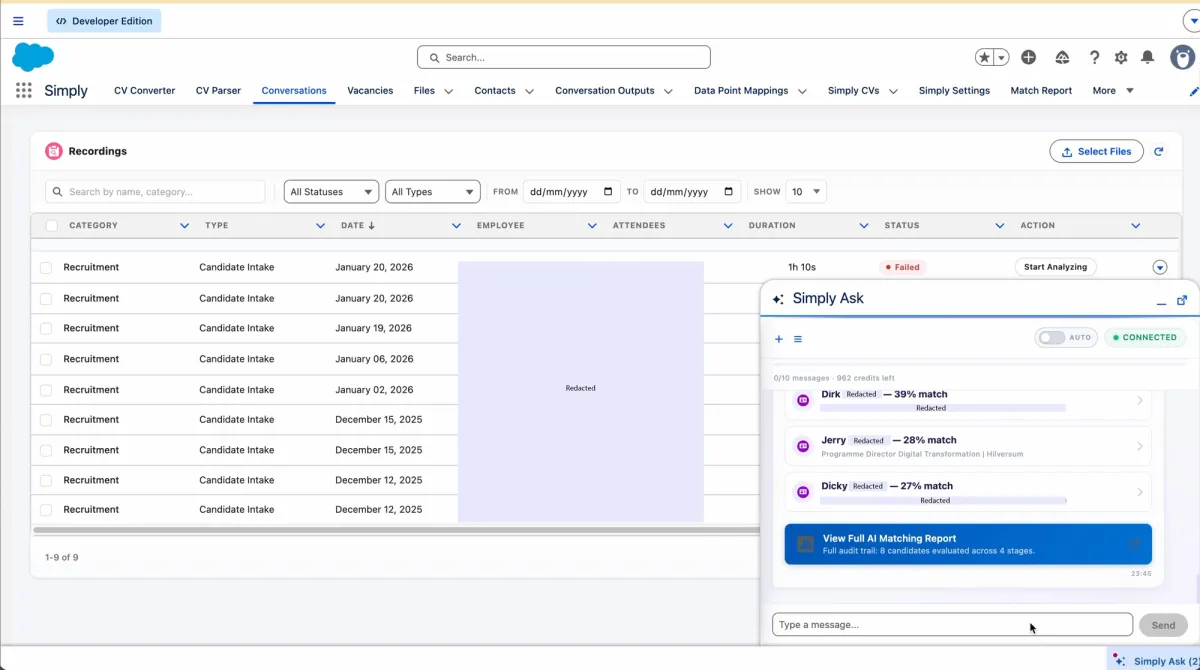
Example of Simply Ask inside Salesforce. Available for any ATS/CRM system.
This isn't a future roadmap item. This is what happens when you combine AI data extraction with an AI engine that understands your workflows.
AI Matching: from thousands of candidates to a top 5
"AI matching" is a term everyone uses. But almost nobody can explain how their matching actually works. At Simply we can, because transparency isn't marketing. It's a requirement.
The system works as a funnel with four stages. Each stage filters out candidates that don't fit, so you end up with a top 5 that's genuinely relevant.
Stage 1: Hard filtering. Candidates who don't meet basic requirements are eliminated immediately. Wrong region, not available, missing certifications. From thousands to hundreds. Purely on factual criteria.
Stage 2: Meaning-based matching. The remaining candidates are compared against the vacancy based on meaning, not keywords. So someone with "project management in construction" on their CV also matches a vacancy for "coordination of civil engineering projects." Because the content aligns, not the exact words. From hundreds to the top tens.
Stage 3: Weighted scoring. The top candidates get scored on six criteria. The weights are based on peer-reviewed research (Sackett et al. 2022, Schmidt & Hunter 1998):
- Skills: 45%
- Work experience: 20%
- Education: 10%
- Domain/industry fit: 10%
- Language: 10%
- Location: 5%
Every score is visible. You can see exactly why candidate A scores 82 and candidate B scores 74. No black box.
Stage 4: AI refinement. The last stage lets an AI model fine-tune the rankings on things that are hard to capture in rules: career trajectory, potential for domain transfer, how someone upskills. But this AI can only adjust scores by a maximum of 10%. No blank check, just a second pair of eyes.
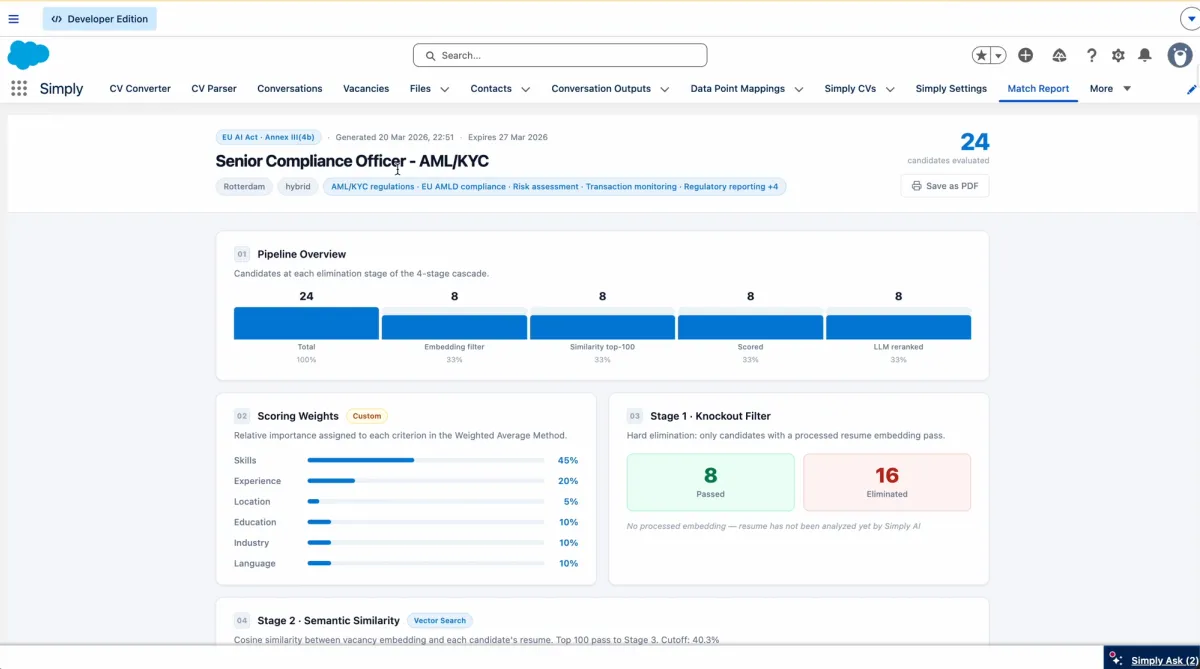
Example of a Simply matching report with per-criterion scoring.
The result: a top 5 with per-criterion explanations. Exactly what makes Simply Insights so valuable. You don't just see who fits best. You see why. And you can explain it to your client.
EU AI Act: why this matters right now
Recruitment AI falls under Annex III of the EU AI Act. That makes it high risk. From 2026 onwards, users of recruitment AI need to meet strict requirements. Many tools aren't prepared for this yet.
Simply is. And not because we added a compliance layer at the last minute. It's built into the design.
Explainability. Every match comes with a score per criterion. Not "this candidate scores 87%", but: Skills 91%. Experience 78%. Location 100%. With readable reasoning for each.
Transparency. The scoring model is fully visible. The weights are public (45% skills, 20% experience, etc.). And the AI adjustment is bounded. No hidden factors.
Human oversight. The AI gives recommendations. You decide. Always. Simply presents matches as suggestions, not decisions.
Bias prevention. Protected characteristics like age, gender, and nationality carry zero weight in the matching. Period. They're actively excluded from the scoring process.
Auditability. Every matching operation is fully traceable. Ready for any audit.
For many agencies, this still feels abstract. But the deadlines are approaching. And when you need to prove that your matching system is fair and transparent, you don't want to be starting from scratch. At Simply, that's been built in from day one.
Want to know more about data protection? Read about our enterprise security and ISO-27001 certification.
What actually changes in your daily work?
Let's be honest. Most recruiters spend the majority of their day on admin. Filling in CRM fields, formatting CVs, searching the ATS, typing emails. The real work (having conversations, building relationships) takes a back seat.
With Simply Ask, you flip that.
Scenario 1: New vacancy just came in.
You type: "Match candidates for the Senior Java Developer vacancy in Amsterdam." Simply searches your entire database, applies the 4-stage funnel, and gives you a top 5 with explanations. In seconds, not hours.
Scenario 2: Need a CV for a client.
"Generate a CV for candidate Jan de Vries in our brand template." Simply grabs the profile, formats it using your template via CV formatting, and the output is ready to send.
Scenario 3: Writing an introduction.
"Write an introduction for this candidate, tailored to the vacancy at TechCorp." Simply analyzes the candidate profile and the vacancy, highlights relevant experience, and generates a tailored introduction. Work history stays intact, but what's relevant for this vacancy gets positioned more prominently.
Scenario 4: Email to hiring manager.
"Draft an email to the hiring manager at TechCorp introducing these three candidates." Done. Adjust where needed, send.
This is the difference between a tool that gives you information and a tool that does the work. Combine AI summaries from your conversations with an agent that can take actions, and your day looks very different.
Why this is different from ChatGPT
Every recruiter has played with ChatGPT by now. Maybe had it write a job posting or draft an email. But that's something fundamentally different.
ChatGPT doesn't know your ATS. It doesn't know which fields you have, which candidates are in your database, or what your CV template looks like. It's a generalist. Simply Ask is a specialist that lives inside your system.
The difference? Context. Simply Ask knows that "available" in your ATS is a dropdown with three options. It knows you have 12,000 candidates in the Utrecht region. It knows what your branded CV looks like. Contextual recruitment makes answers not just faster, but better. The AI makes fewer mistakes because it knows the constraints.
And that transparency isn't optional. Every action Simply Ask takes is traceable. Every AI conclusion can be traced back to the source data. That's not just nice for you. It's a requirement under the EU AI Act.
Curious how other teams use AI? Read 11 practical uses of AI in recruitment or why AI is not a threat to recruiters.
The recruiter stays in control
Simply Ask and AI Matching are tools. Instruments. They make you faster and give you better information. But the decision? That stays with you.
The AI ranks candidates. You choose who to call. The AI writes an introduction. You adjust it and send it. The AI suggests a task. You confirm.
That's not a limitation. That's the whole point. The best recruiters won't be replaced by AI. They'll be strengthened by it. Less time on admin, more time doing what they're good at: connecting people with the right opportunities.
Want to see how Simply Ask works with your ATS? Request a demo and we'll show you with your own data.