Recruitment AI for search & selection (2026)

Why S&S is a different AI question
Search & selection runs on fees. A fixed amount or a percentage of the annual salary, paid the moment a candidate signs and stays. That sounds simple, but it changes everything about which recruitment AI works for you and which does not.
Look at the math. A staffing firm earns a few tens of euros margin per hour per temp worker, across hundreds of placements. For you it works the other way round. One placement of a controller at 90,000 euros against a 22% fee is nearly 20,000 euros. But that fee only lands if the match is right. And in case of doubt it does not get paid, or worse, you lose the relationship.
That is the whole point. Your margin is not in throughput. It is in depth. In how well you understand what a hiring manager is really looking for behind the job profile, and how well you read a candidate beyond what the CV says. A tool that helps you screen thirty candidates in a day does not help you. A tool that helps you truly understand five candidates, that is where your money is.
This is exactly why the broader guide on recruitment AI per agency type treats S&S as a separate segment. Here we go deeper. Which AI layer strengthens your fee economics, and which quietly undermines it?
The fee economics of an S&S firm
Before we get to tools, let us sharpen the economics underneath. Because it determines everything.
An S&S firm lives on a handful of numbers. The fee per placement. The number of assignments you can carry at once. And, most important and most underestimated: the chance a client comes back. That last number is your real profit engine. Winning a new client costs you acquisition, pitching, building trust. An existing client who calls back because the last match was spot on costs you a phone call.
Run the numbers. Say you do 40 placements a year at an average fee of 15,000 euros. That is 600,000 euros in revenue. Now the question that matters: how much of that comes from clients you already knew? At a healthy S&S firm it is more than half. At an excellent firm it is three quarters. That repeat business is no accident. It is earned with matches that stuck and with reporting that showed the hiring manager you understood their business.
This is where "volume" thinking falls apart. The time you save by screening faster is almost never the time that costs you money. The time that costs you money sits in the wrong placement, in the match that walks away after three months, in the hiring manager who stops calling you back. No tool built for speed solves that. In fact, some make it worse.
| What you save | What it is actually worth |
|---|---|
| 10 minutes per intake write-up | Marginal. Admin is not a fee. |
| Pre-screening 30 candidates faster | Risk. Depth disappears, mismatch odds rise. |
| Catching a mismatch before the shortlist | High. Prevents a lost placement. |
| A hiring manager report that lands | Direct. This wins the next assignment. |
The right-hand column is where AI makes a difference for an S&S firm. The left-hand column is what most tools sell.
The AI stack that strengthens your fee
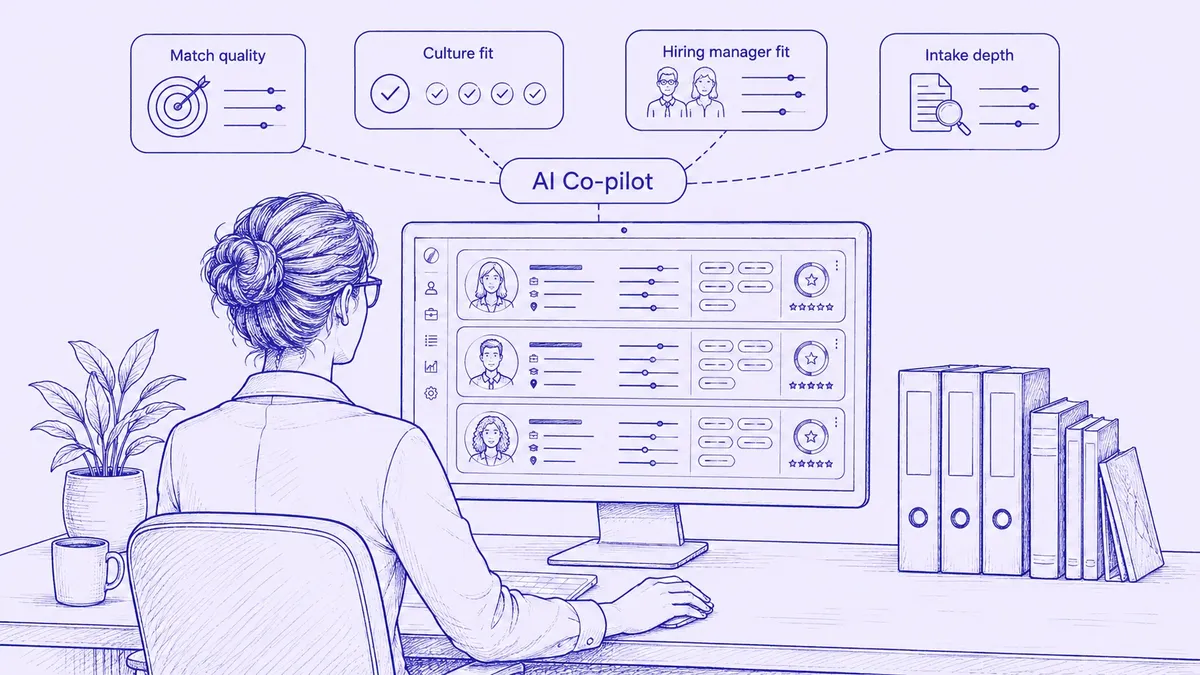
Good recruitment AI for S&S does one thing: it makes you deeper, not faster. Concretely, that means four things.
Recruitment intelligence beyond CV matching. A CV tells you what someone has done. It does not tell you why they left, what energizes them, whether they want to lead or specifically do not, and whether the career arc points toward this role or away from it. Those signals sit in the conversation. An AI layer that reads the intake conversation for motivation, career direction and soft signals gives you a profile no CV parser can approach. This is the difference between conversation intelligence and simple transcription. The first thinks along. The second types along.
Structured reporting toward the hiring manager. This is your differentiator, and it is badly underrated. A shortlist that only holds names and scores is a commodity. A shortlist where each candidate comes with why they fit, backed by what they said in the conversation, is advice. The hiring manager feels the difference immediately. AI that produces a structured summary per conversation type, candidate intake, vacancy intake, evaluation, gives you the building blocks for reporting that strengthens the relationship instead of merely informing it.
Clickable transparency. Suppose you put a candidate at the top of the shortlist and the hiring manager asks why. "My gut" is not an answer that justifies a fee. "Because in the conversation she said she was looking for exactly this step up, here, listen" is an answer that builds trust. Tools where every sentence in the summary is clickable and links back to the exact moment in the conversation give you that backing. Not for yourself, but for the conversation with the client.
Notetakers with candidate insights across multiple conversations. An S&S process is rarely one conversation. You speak to a candidate at intake, after a client meeting, after an assessment. A tool that picks up patterns across those conversations, "in every conversation she names autonomy as decisive", gives you insight a single conversation cannot. That is recruitment intelligence in practice: not summarizing per conversation, but understanding across conversations.
Four layers. All aimed at depth. None of the four at speed.
What actually works against your fee
Now the part most S&S firms get wrong. Because the market pushes you toward volume tools, and that marketing is convincing.
Mass-screening tools promise you sort hundreds of candidates in minutes. For a staffing firm that is gold. For you it is poison. The reason is exactly the fee economics above: your value sits in the depth such a tool automates away. If you reduce a candidate to a match score of 87%, you throw away what you are paid for. The hiring manager can run an ATS that spits out scores by themselves. They do not need you for that.
Watch the signals in the demo. A tool boasting about "10x more candidates per recruiter" or "autonomous shortlisting" is built for a different agency type than yours. The per-agency-type analysis calls this pitfall two: buying shiny features that do not fit your economics. At S&S that pitfall is costlier than elsewhere, because the tool literally automates the part of the work your fee is paid for.
A second category to be careful with: autonomous rejection agents. Not because they do not work, but because at S&S they are rarely worth it. You work with small numbers and high stakes. The time you gain by automating a rejection pales against the risk of brushing off a candidate who later reaches your hiring manager through a connection. In a market where reputation is your entire asset, that is not a trade you want to make.
In short: when in doubt, choose the tool that lets you slow down at the right moments, not the tool that forces you to speed up.

Simply
Simply sits in the recruitment intelligence category, alongside tools like Metaview, Carv and In2Dialog. We are not an ATS and not a mass-screening tool. We are a co-pilot that reads the conversation and removes the work around it, so you spend your time on the depth your fee comes from. For an S&S firm it fits on four points.
AI summaries per conversation type. A candidate intake calls for a different structure than a vacancy intake or an evaluation conversation. Our summaries are template-based per conversation type and adjustable per firm, so the output is directly usable as a building block for your hiring manager reporting.
Clickable transparency. Every sentence in the summary is clickable and links back to the exact moment in the audio. When a hiring manager asks why a candidate is at the top, you have the evidence one click away. That is not a feature for you, it is a feature for the conversation with your client.
Deep insights. Simply analyzes candidate traits across multiple conversations and also gives insight into recruiter skills, so you not only understand the candidate better but also sharpen your own intake technique.
Smart CRM data entry with validation. Fields like desired salary, current role and availability are recognized and formatted automatically, with a validation system that flags uncertain extractions. No re-typing, but full control.
Honest about the boundary: for pure executive search with one assignment a month a conversation layer is probably overkill, and for a staffing firm running on 90-second intakes we miss the volume features. For an S&S firm that lives on the quality of the intake and the relationship with the hiring manager, we fit precisely. We would rather say that in the first conversation than in month three.
Want more on the agency economics of S&S, read the for-whom page for search & selection.
Compliance: short but not optional
Two regimes run in parallel, and at S&S you can ignore neither.
The GDPR gives every candidate rights around access, deletion and, in automated decision-making, the right to human intervention. At S&S you work by definition with human judgment, so that right is usually well covered, provided your AI tool plays a supporting role and does not reject on its own.
The EU AI Act makes recruitment AI high-risk from 2 August 2026. That means requirements around risk management, data governance, logging, human oversight and accuracy. For you as a firm the practical question is simple: can your vendor show that the tool meets these requirements, with documentation and audit logs? If not, you inherit the legal exposure. The guide on GDPR and the AI Act for recruitment tools walks through this point by point.
The reassurance for S&S: because your work inherently runs on depth and human judgment, it fits well within what the AI Act asks. A tool that supports you instead of replacing you is exactly what the legislator has in mind. The firms that get into trouble are the ones that automated rejection at scale. That is not your model anyway.
Where to start
No platform purchase, no annual contract based on a demo. Three steps.
Step 1. Calculate your repeat revenue. What percentage of your placements comes from clients who already came back to you before? That number is your real profit engine and it immediately makes clear where AI should help: with the quality of the match and the reporting, not with throughput.
Step 2. Take your three biggest time sinks that produce no fee. For most S&S firms those are conversation write-ups, drafting hiring manager reports, and CRM data entry. That is where your first gain sits, and the nice part is that the tools solving this make you deeper rather than faster-and-shallower.
Step 3. Pilot one conversation layer on one recruiter, six weeks, with a metric set in advance. Not "feels good", but "saves me two hours per assignment that I now put into extra candidate research". Measure the outcome against your fee economics, not against a time-saving dashboard.
Start with your money. Not with the tool.