AI Screening Tools: How They Work and How to Choose

In short
* AI screening tools automate the first pass of hiring. They read CVs, rank candidates against role criteria, run assessments or analyze recorded interviews, so recruiters spend less time on manual review.
* There are four broad types: CV screening, assessment-based screening, async video screening, and chatbot pre-screening. Most platforms combine two or three of these.
* The upside is speed and consistency at volume. The risk is that a tool trained on biased history filters out qualified people, which is why the EU AI Act treats hiring AI as high-risk.
* A screening tool is only as accurate as the data it reads. Keyword-matching a thin CV misses the context that actually predicts fit.
* Choose on transparency, bias auditing and data quality, not on how impressive the ranking looks.
What are AI screening tools?
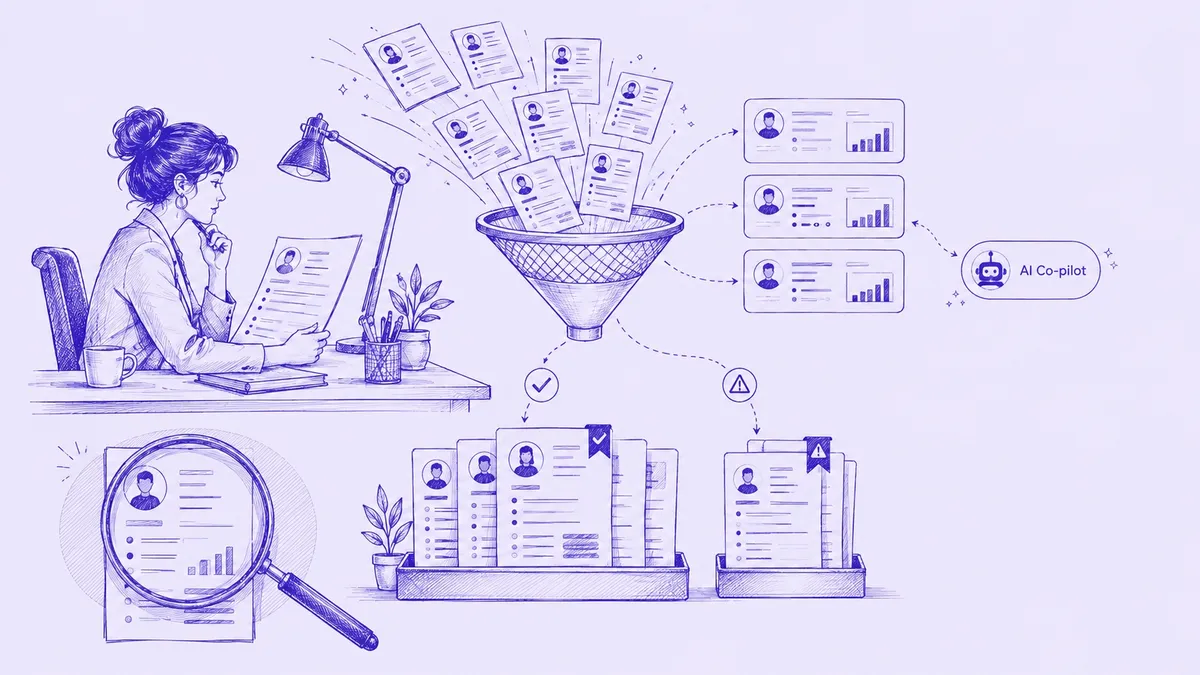
AI screening tools are software that uses machine learning to evaluate job applicants automatically, before a human looks at them. They read CVs, score candidates against a role, run skills tests or analyze recorded interviews, and return a ranked shortlist. The point is to shrink the manual first pass from hours to minutes.
This is a step beyond the old keyword filter built into most applicant tracking systems. A classic ATS matched literal words: type "project manager" into the search and it surfaced CVs containing that exact phrase. Modern AI screening uses natural language processing to read context, so it can recognize that "led a cross-functional delivery team" is relevant even when the words do not match. That sounds smarter, and often it is. It also makes the reasoning harder to see, which is where the trouble starts.
One word of warning about the term itself. "Screening" covers several different jobs: sifting CVs, testing skills, watching a recorded interview, or asking knock-out questions in a chat. When a vendor says its tool "screens candidates," always ask which of those it actually does.
The main types of AI screening tools
There is no single kind of AI screening tool. Most products fall into one of four categories, and the better-known platforms stitch a few together into one workflow. Knowing which type you are looking at tells you what it can and cannot judge.
| Type | What it evaluates | Best used for | Main limitation |
|---|---|---|---|
| CV / resume screening | Parses and ranks CVs against role criteria | High-volume roles with many applicants | Only as good as the CV and the keywords in it |
| Assessment-based screening | Skills, cognitive or work-sample tests, scored by AI | Validating ability the CV does not prove | Candidate drop-off; the test has to be valid for the role |
| Async video screening | One-way recorded interviews, analyzing answers | Early-stage filtering at scale | Facial and voice analysis is legally risky and banned in places |
| Chatbot pre-screening | A conversational bot asks knock-out questions | Qualifying applicants the moment they apply | Shallow and rules-based, limited nuance |
Notice that each type reads a different signal. CV screening reads what a candidate wrote about themselves. Assessment screening reads what they can do. Video and chatbot screening read how they respond in the moment. None of them read the one thing recruiters trust most, which is a real conversation. Hold that thought, because it becomes the whole point later.
What AI screening tools do well
Used well, AI screening buys back time and adds consistency. At volume, that matters. Eye-tracking research from Ladders found recruiters spend an average of just 7.4 seconds on a first CV scan, and that attention only thins out across hundreds of applications. When the first pass runs on 7.4 seconds of tired human focus, the quality of that pass drops fast. A tool that applies the same rubric to applicant number 300 as to number one has a real advantage there.
The three genuine benefits are worth naming:
Speed.* The first sift stops being the bottleneck. Recruiters spend their hours on conversations instead of scrolling.
Consistency.* The same criteria get applied to every candidate, which removes some of the drift that creeps in when a human reviews the fortieth CV of the day.
Reach.* Because the machine does not tire, more applicants get a genuine look instead of being cut by the arbitrary line of "we stopped reading at CV 80."
That last point is the strongest argument for screening automation, and it is also the one most easily undone. A tool only widens your reach if it judges fairly. If it does not, it just rejects more people, faster.
Where AI screening goes wrong: bias and compliance
The biggest risk with AI screening is that a tool trained on your past hiring learns your past bias, then applies it at scale and calls it objective. This is not hypothetical. Amazon scrapped an internal recruiting AI in 2018 after finding it downgraded CVs that included the word "women's," because it had been trained on a decade of mostly male hires.
The scale of the quieter problem is bigger. In the Harvard Business School and Accenture study "Hidden Workers: Untapped Talent," 88% of employers agreed that qualified, high-skilled candidates are filtered out of their process by screening software because they do not match the exact criteria. The same study counted more than 27 million such hidden workers in the United States alone. That is millions of capable people rejected by a rule nobody meant to write.
Regulators have caught up. Since July 2023, New York City requires an independent annual bias audit for any automated employment decision tool used in hiring, plus candidate notification — and following a critical audit by the New York State Comptroller in late 2025, stricter enforcement is now expected. In Europe, the EU AI Act classifies AI used for recruitment and candidate selection as high-risk, with obligations on transparency, human oversight and data governance taking effect on 2 August 2026. If you screen with AI, you now carry a compliance duty, not just a productivity gain. For the detail on that, see our guide to the EU AI Act and GDPR for recruitment tools, and on removing bias at the source, anonymizing CVs to reduce bias.
How to choose an AI screening tool
Judge an AI screening tool on how defensible its decisions are, not on how slick the ranking looks. Test every vendor on six things: transparency, independent bias auditing, GDPR and EU AI Act compliance, the quality of the data it reads, a human on the final call, and clean integration with your ATS. A high score you cannot explain is a liability, not a feature. Run any shortlisted vendor through six checks:
- Transparency. Can it show why a candidate ranked where they did, in terms a hiring manager can read? If the answer is a black box, walk away.
- Bias auditing. Has the tool been independently audited, and will the vendor share the results? This is the direction NYC law already points, and good vendors do it voluntarily.
- Compliance. GDPR by design, and a clear position on the EU AI Act's high-risk obligations. Ask where candidate data is stored and whether it trains their models.
- Data quality in. What is the tool actually reading? A ranking built on half-empty CV fields is a confident guess, nothing more.
- Human-in-the-loop. A candidate should never be auto-rejected with no human able to see and overturn the call. Keep a person on the final decision.
- Integration. It has to write back cleanly into your ATS or CRM. A screening score stranded in a separate tool creates the data silos you were trying to escape.
Most of these come down to one question underneath: can you defend this decision to the candidate, to your client, and to a regulator? If yes, the tool is doing its job. If no, the speed is not worth it.
Screening is only as good as the data underneath it
Here is the part the tool lists skip. A screening algorithm is a function of its input. Feed it a two-page CV and it screens on two pages. But the signal that best predicts whether someone fits, the intake conversation, the interview, the phone call where the candidate explains why they are actually leaving, almost never becomes structured data. It stays in someone's head and in loose notes. So the "AI" screens a thin, formal document and misses the rich picture the recruiter already has.
This is why data quality sits underneath everything else in recruitment intelligence. Cleaner input beats a cleverer algorithm nearly every time. Three things decide whether your screening rests on solid ground: whether conversation data actually lands in your system, whether you know which fields are reliable, and whether you can trace where each detail came from. When those are fragmented, screening amplifies the gaps. We wrote about that failure mode in ending fragmented recruitment data and conversation intelligence for recruitment.
This is where it helps to be precise about what Simply is and is not. Simply does not rank or reject candidates, and it is not an AI screening filter. It works one layer earlier, on the data those decisions rest on. It captures conversations across every channel, turns them into structured fields with CV parsing and smart CRM data entry, validates each field as certain or doubtful, and keeps every detail traceable back to the moment it was said. Whatever you screen with afterwards, it screens on a complete and honest record instead of a keyword-thin one.
From screening to a decision you can defend
AI screening tools are worth having. They take the grind out of the first pass and give every applicant a fairer look than a tired human at CV number 200. But they are not judgment, and they are not neutral by default. A tool trained on biased history will reject faster, not fairer, and regulators now expect you to prove it does not.
So do not start with the ranking. Start with the input. The best screening decision is the one you can explain, and you can only explain it when the data underneath is complete, reliable and traceable. Get that right and the tool becomes an assistant. Get it wrong and it becomes a very fast way to make the same old mistakes.
Simply is the recruitment-intelligence co-pilot that keeps that foundation clean: meeting bots for Meet and Teams, a desktop and mobile app, and VOIP for phone calls, with per-field validation and a traceable line back to the source. ISO 27001 certified, GDPR compliant, and without using your data to train models. Want to see how clean data changes what your screening can do? See how Simply works.